
Pressure Pots for Resin Casting: Why, Which, and How to Set One Up
I cast my Alumilite in a pressure pot. I've set up somewhere around seven of them over the years: Harbor Freight pots, an old Craftsman-style pot off Craigslist, and TCP Global pots in 2.5, 5 and 10 gallon sizes. This guide pulls together what I've learned.
By the end you'll know why I use a pressure pot instead of a vacuum chamber, which pot I'd buy today, how to plumb it and bolt it down, how to check it for leaks, and what pressure and time I actually run.
Why a pressure pot for resin casting
Alumilite has a short working time, anywhere from five to seven minutes depending on the type you use. There's no time to pull the air out in a vacuum chamber before it starts to harden. In a pressure pot, the bubbles get squeezed down to a size you can't see within seconds of pressurizing.
Which pressure pot I'd pick
- Harbor Freight. The most popular pot in the casting community because it's easy to get and cheap. Max pressure is 60 PSI and I fill mine to 50. They're reliable once modified, but you pretty much have to redo the factory thread sealant on everything, the wing bolts press right on the lid and scrape it over time, and there are no feet, so you have to build a holder to stop it twisting.
- TCP Global (older paint-pot versions). My step up from Harbor Freight. Thicker metal, big wing nuts you can get your whole hand on, and feet you can bolt to the bench. The catch was the hole for the paint mixing agitator, which you had to plug yourself (step 3 below).
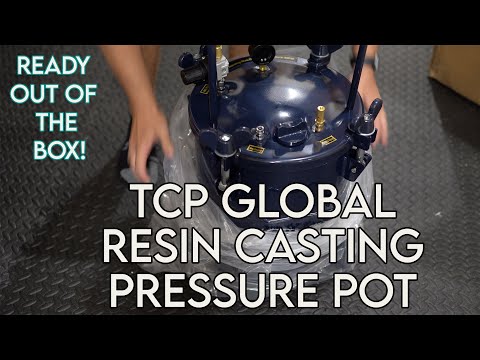
- TCP Global resin casting pot (5 gallon). This is the one made for resin casting. There's no agitator hole, just one air inlet, a regulator, a separate gauge and a safety valve. It's ready to cast out of the box. It's rated at 50 PSI maximum operating pressure. Inside it's about 12 3/4 inches across (I'd plan molds around 12 1/4) and a little under 14 inches deep.
- TCP Global 10 gallon. Massive: about 18 inches deep and a little under 14 3/4 inches wide, with five wing nuts instead of four. I'd feel comfortable casting something 14 inches long in it. The one I have still came with the regulator assembly on a swivel fitting and no air hookup, so it needs a little replumbing.
Whatever you buy, if you're choosing between a pot with the caster feet and one without, get the one with feet. They let you bolt it down, and they make turning it on its side for long molds easy.
What you need
- A pressure pot (see above) and an air compressor with a hose
- A male air fitting (air hose nipple) for the pot's inlet
- Thread sealant, and plugs for any ports you aren't using
- A spray bottle of soapy water for finding leaks
- Screws, plus scrap wood or 2x4 offcuts for bolting the pot down or building a holder
- Big pliers or a wrench for fittings
- For an older pot with a mixing agitator: a hand hacksaw
- A mold rack or a lid to cover your molds
How to set up a pressure pot, step by step
Step 1: Lock the pot down
You tighten and loosen the wing nuts every single cast, and the pot will twist on you if it isn't anchored.
- Pot with feet (TCP and similar): screw through the caster holes straight into the bench.
- Pot without feet (Harbor Freight style): trace the bottom of the pot on a board, drill a starter hole and cut the circle with a jigsaw so the pot sinks in and hangs on its bolt assemblies.
- Cut four scrap blocks from a 2x4, big enough to take two screws without splitting. Put one on each side of two opposite bolt assemblies and screw them down tight. Now the pot can't turn either way when you crank or loosen the nuts.

Step 2: Replumb the lid
Almost every manufacturer puts the regulator on a swivel fitting, the kind that turns without unscrewing. No matter how tight you get those, in my experience they always leak.
- Take the assembly off the swivel fitting and screw it straight into the quarter-inch threads in the lid, with thread sealant. On the 10 gallon, the bare minimum is to do that and put an air hose nipple on top.
- Older TCP pots came with two ball valves. Keep one for your air line with a male fitting on it, and use or cap the other.
- Plug any other ports you don't need, with thread sealant.
- Leave the safety valve in. On the TCP pots the factory sealing has held fine for me; on Harbor Freight pots I redo the sealant on everything.
Step 3: Deal with the agitator hole (older paint pots only)
Skip this if your pot is a resin casting version.
- My current method: loosen the collars with the Allen screws, pull the rod up as far as it goes, mark it, cut it with a hacksaw, and put it back in and tighten the collars. It's designed to be airtight that way, so it doesn't leak.
- What changed: on my first TCP (2.5 gallon) I pulled the rod out and plugged the hole with a 5/8 inch bolt and rubber washers. That plug was the only spot on that pot that leaked, so I switched to cutting the rod. If you do use a bolt, put a metal washer over each rubber one so the pressure spreads evenly.
- If the pot has a metal paint tube hanging down from the lid and you can't unscrew it, cut it off. Make sure it ends up shorter than the lowest part of the lid so it can't hit your mold rack.

Step 4: Set the regulator and safety valve
I set the regulator so the pot stops filling where I want it, so I can never go past that. Safety valves are adjustable. If yours pops off or hisses before you reach your pressure, adjust it. Stay under the pot's rated maximum. The ratings aren't something to completely trust, so on my older 5 gallon TCP (rated to 80) I wanted to stay about 10 PSI under that.
Step 5: Leak test it
- Fill to your casting pressure and watch the gauge. If there's a real leak, you'll usually see the needle drop within a few seconds.
- Leave it for the time you'd normally cast (about two hours for me) and check the gauge again.
- Spray soapy water on the fittings to find exactly where it's leaking, then pull that fitting and reseal it.
Step 6: Cast
Put a lid on your molds or cover what you're casting, and fill slowly so you don't splash resin. The TCP pots don't have the threaded inlet that takes an air deflector like the Harbor Freight ones, so covering the molds matters. A 5 gallon pot filled slowly takes almost a minute to get to 50 PSI, and with Alumilite you don't have a lot of time, so have everything ready. I leave the resin under pressure for about two hours, two and a half at most.
Step 7 (optional): Turn it on its side for long molds
Standing up, my 5 gallon TCP fits about 10 to 11 inch molds. On its side it fits 12 inches, maybe close to 13 with thinner mold ends, and still gives about 12 1/2 inches of height. I screwed two pieces of scrap into an L, screwed that to the bench, and screwed through two of the feet into it. Don't try this with a Harbor Freight pot; with no feet it wants to roll.

Common problems and fixes
Pressure drops over a few hours
The usual suspects are the swivel fitting, factory plugs and any plug you made yourself. Soapy water will show you which one. Screw the regulator straight into the lid and reseal anything that bubbles. A small drop is fine. My new 5 gallon TCP went from about 49 to 42 or 43 PSI over two hours, and I called it ready to go.
The pot won't fill
The first time I tried my TCP resin casting pot it wouldn't fill and I started taking parts off. It was just the regulator setting. Check the regulator before you take anything apart.
The safety valve hisses below my target pressure
That's the valve's set point, not a failure. Adjust it, or fill to a bit less. On one pot mine started hissing at about 58 or 59, so I let it down to about 52 and planned to tighten the valve later.
Resin splattered inside the pot
That happened to me when I forgot to put a lid on one of my molds. Cover your molds and fill slowly.
The pot twists when I tighten the wing nuts
Bolt it down through the feet, or sink it into a board with blocks on each side of the bolt assemblies (step 1).
FAQ
Is a pressure pot or a vacuum chamber better for Alumilite?
A pressure pot. Alumilite's working time is five to seven minutes, which isn't enough time to degas it in a vacuum chamber. Pressure shrinks the bubbles out of sight within seconds of filling.
What PSI should I use in a pressure pot for resin casting?
My general level is 40 PSI: all resins are going to be okay around 40. I fill to about 50 so that even after a few hours with a small leak it's still above 40. In my early videos I ran a TCP 2.5 gallon at 80 PSI because it was rated to 90. The resin casting 5 gallon is rated at 50 PSI maximum operating pressure, and I don't want to recommend going over a pot's rating.
How long do I leave resin in the pressure pot?
About two hours, two and a half at most. In one older video I said three to three and a half hours; about two hours is what I do now.
Harbor Freight or TCP Global pressure pot?
Harbor Freight pots are a great way to get into casting, and I've used mine hundreds of times. TCP Global pots are heavier, have bigger wing nuts that don't scrape the lid, and have feet to bolt down. Their resin casting version needs almost no setup. If I'm getting another pot, I'm going the TCP route.
What size pressure pot do I need?
Go by your molds. A 5 gallon fits about 10 to 11 inch molds standing up, or 12 inches on its side. The 10 gallon takes about 14 inch long pieces and has 18 inches of height for stacking. For short molds stacked high, the bigger pot standing up beats a smaller one on its side.
Is a small leak a problem?
Not if it stays above 40 PSI for the time your resin is in the pot. I fix leaks anyway because I like the pressure to be the same when I come back, especially when I'm casting in colder weather.
Want to see what comes out of these pots? The grapevine and metal leaf blanks below are cast in Alumilite, the resin this whole guide is built around.

